
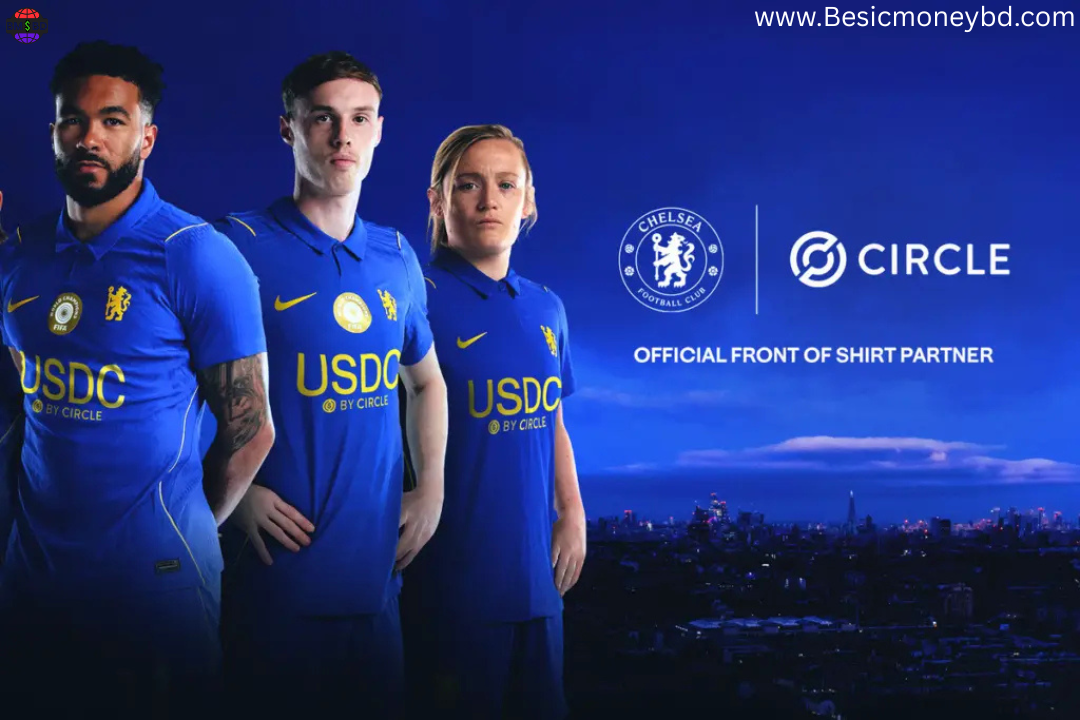
Circle has entered one of the biggest football sponsorship markets in the world after signing a one-year Principal Partner agreement with Chelsea FC for the 2026/27 season. The deal will place “USDC by CIRCLE” branding across Chelsea’s men’s, women’s, and academy shirts, giving the stablecoin issuer global exposure through one of England’s most recognizable football clubs.
The sponsorship is reportedly valued at between £33.6 million and £50 million, making it a significant commercial agreement for both Circle and Chelsea. More importantly, the partnership arrives at a critical moment for the cryptocurrency industry in the United Kingdom, where regulators are preparing a new framework for crypto assets while existing rules leave important questions around stablecoins and financial promotions.
The Chelsea shirt carrying Circle’s branding debuted on August 31 during Chelsea’s 2-1 Premier League victory over Brighton. The match was also notable because it marked Xabi Alonso’s first Premier League home game as Chelsea manager.
With Premier League matches reaching audiences around the world, the sponsorship gives Circle an enormous mainstream marketing platform. The league reportedly reaches billions of viewers globally over the course of a season, meaning the USDC logo could become familiar to millions of football fans who may have little previous exposure to stablecoins.
Why Chelsea and Circle Came Together
Chelsea’s search for a major shirt sponsor has been complicated in recent years.
The club previously had long-running partnerships with major brands such as Samsung, Yokohama Tyres, and Three. However, following the sanctions against former owner Roman Abramovich and Chelsea’s subsequent £4.25 billion sale to a consortium led by Clearlake Capital and Todd Boehly, the club went through a period of commercial uncertainty.
Several short-term sponsorship agreements followed, including partnerships with Infinite Athlete, DAMAC Properties, and IFS.
For Chelsea, finding a major partner capable of committing significant money while passing corporate and regulatory due diligence was therefore important.
Circle represented a different type of crypto sponsor. Unlike many cryptocurrency companies that entered sports sponsorship during the previous market cycle, Circle is a publicly traded company on the New York Stock Exchange. Its USDC stablecoin is also one of the largest dollar-pegged digital assets in the market.
That corporate profile makes the Chelsea partnership particularly significant. It represents an attempt by a regulated financial technology company to position stablecoins directly alongside traditional global brands.
The FCA Question
The sponsorship is especially interesting because it follows a warning from the UK’s Financial Conduct Authority.
In late May 2026, the FCA warned Premier League clubs about unauthorized financial firms using sports sponsorships to reach consumers. The regulator’s message highlighted concerns that football clubs could provide credibility to financial companies that had not received appropriate authorization.
The warning became particularly relevant after reports that Crypto.com had been pursuing a major sponsorship agreement with Manchester City. That reported deal was ultimately abandoned.
Circle’s situation is different because the company holds an FCA Electronic Money Institution license, No. 900480, which was granted in 2018.
This distinction is important. The sponsorship demonstrates that cryptocurrency-related companies are not necessarily excluded from major UK sports partnerships. Instead, regulatory authorization and the specific financial product being promoted can determine whether a partnership is acceptable.
A Regulatory Gap Around USDC
Despite Circle’s regulatory credentials, there is still an important legal distinction surrounding USDC.
Circle’s disclosures state that USDC itself is not issued or regulated under UK law. This creates an interesting gap between the company promoting the stablecoin and the regulatory status of the product being advertised.
The UK is also preparing to introduce a broader crypto asset regulatory framework. The new regime is expected to reshape how crypto businesses operate and market their products in the country.
This creates a potentially important transition period between the launch of the Chelsea sponsorship and the expected effective date of the new rules in October 2027.
During that period, Circle can market its brand and USDC through one of the world’s most visible football clubs while the UK’s crypto regulatory framework continues to develop.
Why the Deal Matters for Stablecoins
The Chelsea partnership is more than a conventional shirt sponsorship.
Stablecoins are increasingly becoming part of the broader financial infrastructure surrounding cryptocurrency. Unlike speculative tokens, stablecoins such as USDC are designed to maintain a stable value relative to a reference asset, most commonly the U.S. dollar.
By placing USDC directly on a Premier League football shirt, Circle is taking stablecoin awareness beyond crypto-native audiences.
The strategy could help introduce the concept to consumers who have never used a cryptocurrency exchange or interacted with blockchain technology.
It also demonstrates how crypto companies are attempting to move from being associated primarily with trading and speculation toward being recognized as financial infrastructure and payment technology.
The Bigger Picture
Circle’s Chelsea partnership arrives at a time when regulators, financial institutions, and cryptocurrency companies are increasingly competing to define the future role of digital assets.
The FCA’s earlier warnings show that regulators remain concerned about consumer protection and unauthorized financial promotion. At the same time, companies such as Circle are attempting to demonstrate that regulated crypto businesses can operate within mainstream financial and commercial systems.
That tension makes the Chelsea deal particularly noteworthy.
For Chelsea, Circle provides a major commercial partner capable of delivering substantial sponsorship revenue and a globally recognizable brand.
For Circle, the partnership provides something arguably even more valuable: mainstream legitimacy and visibility.
The “USDC by CIRCLE” logo will now appear in front of millions of football fans throughout the 2026/27 season. Whether that exposure translates into greater adoption of USDC remains uncertain, but the symbolism is already clear.
Crypto is no longer confined to exchanges, blockchain conferences, and online communities. Stablecoins are now competing for space alongside traditional financial brands on some of the biggest stages in global sport.
The real test will come as the UK’s regulatory framework catches up with the industry. Until then, Circle’s Chelsea sponsorship represents a fascinating example of how crypto companies can enter mainstream markets while navigating a regulatory environment that is still being built.